
Use this free comparison tool to evaluate your retirement benefits under the Unified Pension Scheme (UPS) and the National Pension System (NPS). Simply enter your Date of Birth, Joining Date, Current Basic Pay, and existing NPS Corpus to instantly compare your assured 50% pension under UPS against the market-linked annuity and 60% lump-sum withdrawal options of the NPS.
Comparison results will appear here
Fill in your details and click calculate.
The Retirement Puzzle: Making Sense of Your Options
Government service used to come with a simple promise: serve the nation, and the nation looks after you in old age. That certainty got a bit complicated with the National Pension System (NPS), and now, with the introduction of the Unified Pension Scheme (UPS), the conversation has shifted again in office canteens and WhatsApp groups across the country.
If you are staring at the calculator above wondering which numbers to put in or what the results actually mean for your family’s future, you aren’t alone. The shift from a market-linked scheme back to a defined benefit model (with a twist) is significant. It isn’t just about “which number is bigger today.” It is about understanding how inflation, your service years, and that tricky “Benchmark Corpus” will play out over the next 20 or 30 years.
This isn’t a lecture on government policy. This is a practical look at how the UPS vs NPS calculator above works, why the math is unique for every single employee, and how to read the fine print that decides your monthly pension.
Understanding UPS and NPS in Simple Terms
Before we dive into the math, let’s strip away the jargon.
The National Pension System (NPS) is essentially a savings pot. You put in money, the government puts in money, and fund managers invest it. When you retire, the size of that pot depends on how the market performed. You take 60% of it as cash (lump sum), and the remaining 40% is used to buy an “annuity”—a financial product that pays you a fixed monthly income for life. The catch? That monthly income stays fixed. It doesn’t usually go up when the price of milk or petrol goes up.
The Unified Pension Scheme (UPS) tries to bring back the “security” of the Old Pension Scheme (OPS) but keeps the funding model of NPS. Under UPS, the government guarantees you a pension of 50% of your average basic pay from the last 12 months before retirement. Crucially, this pension is indexed to inflation. When Dearness Relief (DR) is announced, your pension increases.
However, UPS isn’t a blank check. It is “funded” by your own corpus. The government takes your NPS savings to fund this guarantee. If you have managed your NPS corpus well and it matches the government’s “Benchmark,” you get the full pension. If your corpus is short (maybe you withdrew money early), your pension might dip proportionally.
Using a UPS vs NPS pension comparison tool is helpful because it shows you this trade-off: Do you want the safety of an inflation-protected pension (UPS), or do you trust the market to give you a potentially larger, but fixed, corpus (NPS)?
Why Comparing UPS and NPS Is Not Straightforward
You might think, “Just tell me which pays more.” If only it were that simple.
The comparison is tricky because these two schemes behave differently over time. An NPS pension calculator might show you a higher starting pension today if the annuity rates are high. But five years down the line, that NPS pension amount will be exactly the same, while inflation has eroded its value. Meanwhile, the UPS pension calculator result might start lower (or higher, depending on your pay), but it grows twice a year with Dearness Relief.
There is also the “Benchmark Corpus” factor. In UPS, your pension isn’t just based on your salary; it’s also a function of your savings discipline. The rules state that for the assured pension UPS calculator to give you the full 50%, your personal pension corpus must match a theoretical “Benchmark Corpus.” This is the government’s way of saying, “We will guarantee your pension, provided you didn’t withdraw your savings midway.”
If you took partial withdrawals from your NPS for a child’s marriage or a house, your personal corpus shrinks. Under UPS, this means your guaranteed pension will be reduced proportionally unless you pay that money back. A simple calculator that ignores withdrawals will give you the wrong answer.
How the UPS vs NPS Calculator Works
The tool above is designed to estimate outcomes based on current UPS and NPS guidelines as described in official notifications and public documents. It does not simply multiply your salary by 50%. Instead, it projects your service profile to help you understand how different factors may affect your pension outcome.
1. Choose Your Exit Type Select whether you are retiring normally (Superannuation), taking Voluntary Retirement (VRS), or Resigning.
- Why this matters: The rules change drastically. For example, if you resign, you are not eligible for UPS at all. If you take VRS, you need 25 years of service to qualify for UPS, unlike the 10 years needed for normal retirement.
2. Enter Key Dates Put in your Date of Birth, Joining, and the “Calculation As Of” date.
- Tip: The “Calculation Date” acts as a snapshot. If you want to see your standing today, set it to today’s date. If you want to estimate your position 5 years from now, move the date forward (but remember to estimate your basic pay for that future date too).
3. Salary and Corpus Details Enter your current Basic Pay and your current total NPS Corpus (Employee + Govt contribution + Returns).
- Important: If you have made partial withdrawals that you haven’t put back, enter that amount in the “Past Withdrawals” field. The calculator needs this to adjust your assured payout UPS calculation.
4. The “Benchmark” Checkbox You will see a checkbox asking if you want to “Estimate Benchmark Corpus.”
- Keep it checked if you don’t know your official benchmark figure. The calculator will estimate what your corpus should have been if you had never touched it, based on the returns slider.
5. Future Projections (Sliders) Use the sliders to assume how much your salary might grow (3% is standard increment) and what DA hikes might look like (4% is a safe average).
- Note: The “Pay Commission” toggle allows you to simulate big jumps in salary (like the 8th Pay Commission). These are estimates, but they help you see the long-term impact on your government employee pension calculator results.
👉 Try different values: Once you get a result, go back and tweak the “Life Expectancy” or “NPS Returns” sliders. You will see how UPS remains stable regardless of market returns, while the NPS figure swings wildly.
UPS Pension Calculation Explained (Rule-Based)
Let’s look at how the UPS pension calculation is generally determined based on provisions described in the UPS framework and Gazette notifications. The assured payout follows a defined structure, subject to eligibility conditions and corpus alignment.
The Magic Formula The full pension is 50% of your “Average Basic Pay.”
- This is not your last month’s pay. It is the average of the basic pay drawn during the last 12 months of service.
- Example: If your basic pay was ₹50,000 for 6 months and then rose to ₹52,000 for the next 6 months, the average is ₹51,000. Your full pension would be ₹25,500.
Qualifying Service To get the full 50% pension, you need to complete 25 years (300 months) of service.
- Pro-rata Reduction: If you serve less than 25 years but more than 10 years, your pension is reduced. The formula is: (Service Months / 300) × 50% of Avg Basic Pay
- Minimum Floor: If the calculated amount is very low, the minimum pension UPS 10000 rule kicks in. You are guaranteed at least ₹10,000 per month provided you have served at least 10 years.
The Corpus Adjustment (IC vs BC) This is the most critical part of the UPS Gazette notification pension rules.
- IC (Individual Corpus): This is the money actually sitting in your NPS account.
- BC (Benchmark Corpus): This is the money that would be there if you had invested in the “default” pattern and never withdrew a rupee.
- If your IC is equal to or greater than the BC, you get the full pension.
- If your IC is lower than the BC (because you withdrew money or chose poor investment funds), your pension is multiplied by the ratio of IC/BC.
- Real Talk: This means a partial withdrawal years ago could slightly reduce your monthly pension for life, unless you pay the difference back at retirement.
Family Pension If the pensioner passes away, the spouse receives 60% of the pension the employee was receiving. This is also inflation-indexed.
Lump Sum In addition to the monthly pension, UPS offers a lump sum gratuity-like payment. It is calculated as:
- 10% of (Monthly Basic Pay + DA) × Every completed 6 months of service.
- This does not reduce your monthly pension. It is an extra payment.
The above explanation is based on publicly available UPS framework details and Gazette notifications and is intended for general understanding.
NPS Pension Calculation Explained (Estimation-Based)
The NPS pension calculation works very differently from UPS because it is market-linked and accumulation-based. There is no assured pension amount. The outcome depends on how much corpus is built over time and the annuity conditions prevailing at exit.
1. Corpus Growth
The calculator projects your existing NPS corpus forward to the selected retirement age. It factors in ongoing contributions (typically 10% of Basic + DA from the employee and 14% from the government) and applies an assumed annual rate of return, which can be adjusted using the returns slider.
2. The 60/40 Exit Structure
Under current NPS exit guidelines at age 60 or superannuation, at least 40% of the accumulated corpus is required to be used for purchasing an annuity, while up to 60% may be withdrawn as a tax-free lump sum.
• A higher portion than 40% may be allocated to the annuity if a higher monthly pension is desired, though many retirees prefer retaining a larger lump sum.
3. Annuity-Based Pension Payout
The monthly pension under NPS depends on the annuity rate available at the time of retirement.
• Annuity rates are market-linked and typically range in the mid-single digits, though they can vary over time and across providers.
• Once purchased, the annuity payout is generally fixed for life.
Inflation Consideration
Because the annuity payout does not usually increase with inflation, its real purchasing power may reduce over time. For example, a ₹40,000 monthly pension today may feel significantly lower in real terms after 10–15 years of inflation.
The calculator estimates the NPS pension by applying the selected annuity rate to the annuitised portion of the projected retirement corpus. Results are indicative and intended for comparison and planning purposes.
UPS vs NPS: Practical Differences That Matter at Retirement
When comparing UPS vs NPS, the decision is not just about which option shows a higher number on day one. The real difference lies in how retirement income behaves over time and how much financial responsibility shifts to the retiree.
1. Inflation Protection (Dearness Relief)
This is one of the most important differences.
- UPS: The pension amount is linked to Dearness Relief (DR), which is revised periodically by the government. This helps the pension adjust for inflation over time and preserves purchasing power in later years.
- NPS: The pension received through an annuity is generally fixed. Inflation protection is not automatic and must be managed separately, usually through careful use or investment of the lump sum portion.
2. Lump Sum vs Monthly Income
- NPS: At normal retirement age (60), up to 60% of the accumulated corpus can be withdrawn as a tax-free lump sum. For a large corpus, this can mean significant cash in hand at retirement.
- UPS: Instead of a large corpus withdrawal, the accumulated pension corpus is transferred to a pooled pension fund to support the assured monthly pension. A separate lump sum is paid based on service length, resulting in lower immediate cash but a more predictable monthly income.
3. Market Risk and Financial Responsibility
- UPS: The monthly pension amount is not directly affected by market fluctuations at the time of retirement. This reduces exposure to market timing risk for the pensioner.
- NPS: The final corpus value depends on market performance. A market downturn near retirement can impact the available lump sum and annuity purchase. Managing the lump sum also requires financial planning to avoid longevity risk.
4. Voluntary Retirement and Early Exit
- UPS: Eligibility under voluntary retirement generally requires completion of 25 years of qualifying service. Even when eligible, pension payments typically commence only from the normal superannuation age, not immediately upon exit.
- NPS: Premature exit before age 60 usually requires at least 80% of the accumulated corpus to be used for annuity purchase, significantly limiting lump sum access.
Worked Examples: Seeing the Numbers
Let’s look at three real-world scenarios. To replicate these results, enter the specific values mentioned below into the calculator inputs.
Example 1: Ramesh – The Future Projection (30 Years Service)
Profile: Ramesh joined service in 2007. He wants to know what his pension will look like when he retires in 2037 with 30 years of service.
(Note: For this simulation, we set the Calculation Date to his future retirement date to see the final values directly.)
- Calculator Inputs to Use:
- Type of Exit: Superannuation
- Calculation “As Of” Date: 01 Jan 2036
- Date of Birth: 01 Jan 1976
- Date of Joining Service: 01 Jan 2006 (Resulting in 30 years service)
- Retirement Age: 60
- Current Basic Pay: ₹1,00,000 (Assumed salary at time of retirement)
- Current NPS Corpus: ₹3,00,00,000 (Assumed corpus at retirement)
- Past Withdrawals (Not Repaid): ₹0
- Estimate Benchmark Corpus?: Checked
- UPS Calculation:
- Qualifying Service: 30 years (360 months). This hits the 25-year cap (300 months) for maximum benefits.
- Formula: 50% of the Basic Pay.
- Corpus Adjustment: No withdrawals, so he gets the full pension.
- Result: ₹50,000 per month + Dearness Relief (DR).
- NPS Calculation (Estimated):
- Lump Sum (60%): ₹1.8 Crores.
- Annuity (40%): ₹1.2 Crores.
- Result: Approx ₹60,000 per month (Fixed).
The Verdict: While NPS starts higher, the UPS pension will grow with inflation (DR) and likely overtake the fixed NPS payout within a few years of retirement.
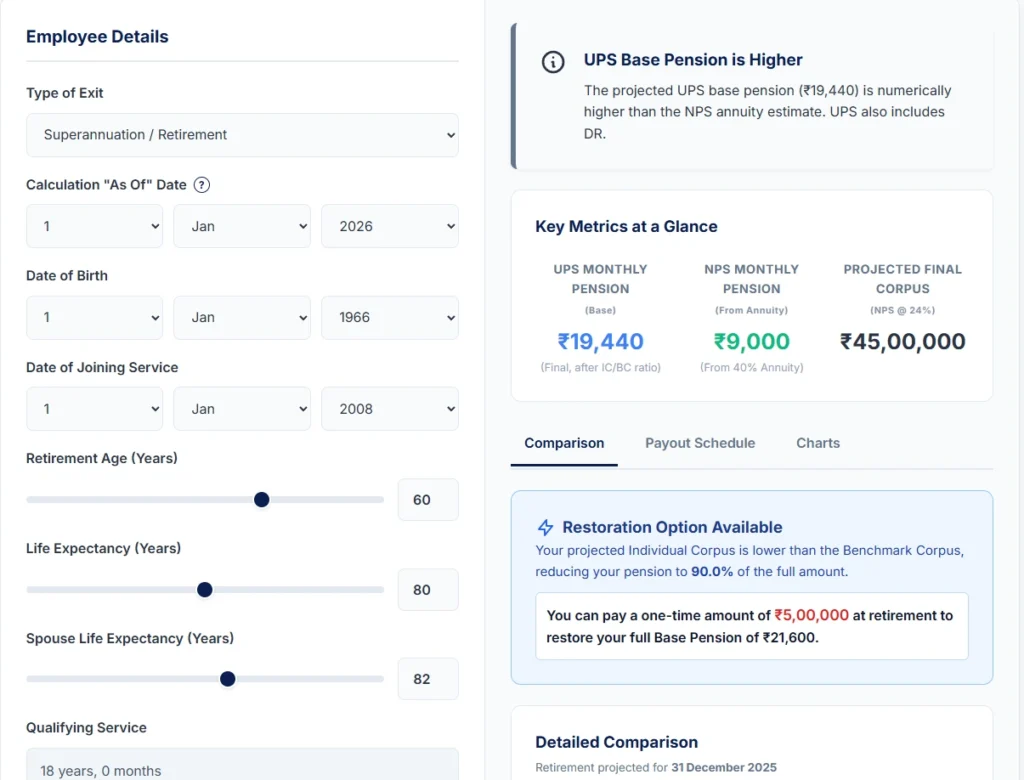
Example 2: Priya – The “Withdrawal” Impact (18 Years Service)
Profile: Priya joined in 2008 and is retiring now in 2026. She made a withdrawal years ago that was never repaid.
- Calculator Inputs to Use:
- Type of Exit: Superannuation
- Calculation “As Of” Date: Today (e.g., Jan 2026)
- Date of Birth: 01 Jan 1966
- Date of Joining Service: 01 Jan 2008 (Resulting in 18 years service)
- Retirement Age: 60
- Current Basic Pay: ₹60,000
- Current NPS Corpus: ₹45,00,000 (This amount creates the specific deficit scenario)
- Past Withdrawals (Not Repaid): ₹5,00,000 (Enter this value to simulate the deficit)
- Estimate Benchmark Corpus?: Checked (✅)
- UPS Calculation:
- Pro-Rata Factor: 216 months (18 years) / 300 months = 0.72.
- Base Pension: ₹60,000 × 50% = ₹30,000.
- Service Adjustment: ₹30,000 × 0.72 = ₹21,600.
- Corpus Adjustment: Because of the withdrawal, her Individual Corpus (₹45L) is lower than the estimated Benchmark (₹50L). Since it is 90% of the benchmark, the pension drops further.
- Result: ₹21,600 × 0.90 = ₹19,440 per month + DR.
The Verdict: Priya pays a penalty twice: once for the pro-rata service (less than 25 years) and again for the corpus deficit. The calculator will suggest a “Restoration Amount” she can pay to fix the corpus gap.
Example 3: Suresh – The Minimum Pension Safety Net
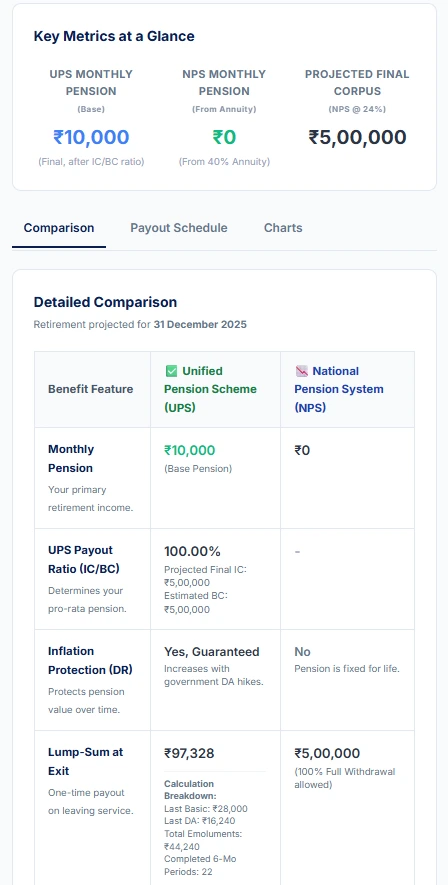
Profile: Suresh joined in 2015 and is retiring now in 2026 with roughly 11 years of service.
- Calculator Inputs to Use:
- Type of Exit: Superannuation
- Calculation “As Of” Date: Today (e.g., Jan 2026)
- Date of Birth: 01 Jan 1966
- Date of Joining Service: 01 Jan 2015 (Resulting in 11 years service)
- Retirement Age: 60
- Current Basic Pay: ₹28,000
- Current NPS Corpus: Low (e.g., ₹5,00,000)
- UPS Calculation:
- Pro-Rata Factor: 132 months (11 years) / 300 months = 0.44.
- Calculated Pension: 50% of ₹28,000 = ₹14,000.
- Service Adjustment: ₹14,000 × 0.44 = ₹6,160.
- Minimum Rule: Since ₹6,160 is below the UPS floor, he is upgraded.
- Result: ₹10,000 per month (Minimum Guaranteed) + DR.
The Verdict: For short-service employees like Suresh, the UPS minimum guarantee provides a safety net that is often significantly higher than what a small NPS corpus could generate as an annuity.
Frequently Asked Questions
Making the Choice
Retirement planning isn’t just about calculations; it’s about long-term comfort and peace of mind. The UPS vs NPS calculator helps you compare scenarios, but the final decision depends on personal priorities.
If you prefer a stable, predictable monthly income that is linked to Dearness Relief, and you are less comfortable with market fluctuations, UPS may feel more suitable. It is structured to provide income continuity throughout retirement, subject to applicable rules and revisions.
On the other hand, if you are financially disciplined, comfortable managing investments, and confident in handling a larger retirement corpus, NPS offers greater flexibility through a combination of lump sum withdrawal and annuity-based income.
Use the calculator to test different assumptions, explore future pay commission impacts, and understand how each option behaves over time. These estimates help frame the decision—but the choice should align with your risk comfort, lifestyle needs, and retirement goals.
Disclaimer
This calculator and the accompanying explanatory contentare providedfor informational and estimation purposes only. They do not represent an official government calculator, pension sanction, or legally binding pension figure.
All results are generated based on user-provided inputsand ourinterpretation of currently available Gazette notifications, draft rules, and publicly accessible guidelines, which are subject to revision, clarification, or change by the Government or regulatory authorities at any time.
Concepts such as “Benchmark Corpus,” future Pay Commission impact, inflation adjustments, and projected returnsareassumptions used solely for estimationand may differ from actual calculations performed by government departments, Pay & Accounts Offices, or pension authorities.
Users are strongly advised to verify figures with official circulars, the concerned department, PFRDA guidelines, or a qualified financial advisor before making any financial or retirement-related decisions.
The website and its owners accept no responsibility or liability for any loss, decision, or action taken based on the calculator results or the related content.