
Enter your pay level, current basic pay, and expected fitment factor to estimate your revised salary under the 8th Pay Commission and compare it with your 7th CPC salary.
Ready to Calculate
Select your Pay Level and Stage to generate a Salary Estimation Report.
Understanding Your 7th vs 8th Pay Commission Salary Comparison
You’ve just seen the numbers on the screen. If the jump in salary looks significant, or perhaps different from what you expected, don’t worry—that’s exactly what this tool is designed to explore.
Our 8th pay commission salary calculator isn’t a crystal ball, but it is a mathematical bridge connecting your current reality under the 7th Pay Commission to the potential future of the 8th CPC. The figures you see above are projections. They are based on the logic that has governed past pay revisions: merging the Dearness Allowance (DA) into basic pay and applying a “fitment factor” to protect your real income against inflation.
While the government hasn’t released the official matrix yet, this comparison gives you a solid “what-if” scenario to help you plan ahead.
What Is the 8th Pay Commission and Why It Matters to You
For Central, State Government employees and pensioners, the Pay Commission is the single most important event affecting financial stability. Constituted approximately every 10 years, it is the mechanism the Government of India uses to revise the salary structure, allowances, and pension benefits of its employees.
Central and State Government employees are currently drawing salary based on the 7th Pay Commission recommendations, which were implemented back in 2016. With inflation rising and the cost of living increasing over the last decade, the demand for the 8th Pay Commission has naturally gained momentum.
Why does this matter right now? Because pay revisions aren’t just about a salary hike; they reset the baseline. They merge the DA you’ve accumulated over 10 years into a new, higher Basic Pay, which then becomes the foundation for your HRA, gratuity, and leave encashment. Using an 8th pay commission salary calculator helps you visualize how this baseline shift impacts your gross monthly income.
The government has now launched the official 8th Central Pay Commission website (8cpc.gov.in), where employees and pensioners can directly submit their memorandums and suggestions regarding the upcoming pay revisions until April 30, 2026.
Quick Look: 7th CPC vs. Expected 8th CPC Structure
To understand why your salary changes, you need to see the structural differences side-by-side.
| Component | 7th Pay Commission (Current) | 8th Pay Commission (Projected) |
| Basic Pay | Based on 2.57 Fitment Factor | Expected Fitment of 1.92 to 2.86 |
| Minimum Pay | ₹18,000 (Level 1) | Estimated ₹34,560 – ₹51,480 |
| DA (Dearness Allowance) | Currently 58%+ | Expected to reset to 0% after merger |
| HRA Rates | 30% / 20% / 10% (Revised) | Likely 24% / 16% / 8% (Rationalized) |
| Fitment Factor | Fixed at 2.57 | Likely variable (1.92 – 2.86) |
7th vs 8th Pay Commission: Key Salary Changes Explained
When you look at a 7th vs 8th CPC salary comparison, you aren’t just looking at a simple percentage hike. The entire structure of your payslip undergoes a transformation. Here is what typically changes during a transition like this:
Basic Pay Reset: Your current Basic Pay + a large portion of your DA is merged to form a new, higher Basic Pay. This is calculated using a “Fitment Factor.”
DA Typically Resets to 0%: Once the new pay structure is implemented, the Dearness Allowance (DA) is typically reset to 0% (or a very low percentage) and starts growing again from there.
Allowances Revision: Allowances like HRA (House Rent Allowance) are often rationalized. For example, in the 7th CPC, HRA rates were reduced to 24%, 16%, and 8% because the Basic Pay on which they were calculated had jumped significantly.
Many employees worry when they see the projected DA drop to zero. This is normal. The expected 8th pay commission salary structure compensates for this loss by drastically increasing your Basic Pay, ensuring your “Gross Salary” sees a net positive jump.
How to Use 8th Pay Commission Salary Calculator – Step by Step and Interpretation of the Results
We have designed this tool to be intuitive, allowing you to visualize a projected pay structure in just a few clicks. Follow this guide to get the most accurate estimation based on your selected assumptions.
Step 1: Input Your Current Details
Select Pay Level: Choose your current Pay Level (L-1 to L-18) from the dropdown menu. This corresponds to your designation group (for example, Level 1 for MTS, Level 7 for Inspectors or ASOs).
Select Basic Pay: Once you choose a level, the second dropdown will populate with the 7th CPC pay stages as per the notified pay matrix. Select your current Basic Pay.
Select HRA Category: Choose your city class (X, Y, or Z). This determines the applicable House Rent Allowance percentage.
Step 2: Adjust the Variables – What-If Scenarios
Fitment Factor Slider: This is the most critical input. The default value is typically set to a conservative estimate such as 1.96. You can adjust this to 2.57 (historical benchmark) or higher values to see how different pay revision scenarios may impact your estimated salary.
Hypothetical DA: In a new pay commission, Dearness Allowance typically resets to 0%. However, if you want to test a scenario where implementation is delayed and DA has already started accumulating (for example, 4% or 10%), you can enter that value here.
Step 3: Analyze and Interpret the Results
Once you click Calculate, the tool generates a comparison table. Here is how to read the results:
Estimated New Basic Pay: This represents your projected base salary under the selected fitment factor. Other components such as HRA, TA, and pension are calculated using this figure.
Gross Salary Difference: The “Net Increase” row shows the estimated difference between your current salary and the projected 8th CPC salary under the chosen assumptions.
DA Reset: You may see DA reduce to zero. This is normal in pay revision scenarios, as the accumulated DA is typically merged into the revised Basic Pay.
💡 Interpretation Tip: If your gross salary increases but certain allowances appear lower, remember that allowances are calculated on a higher Basic Pay. As a result, the actual amount received is often higher even if the percentage rate is reduced.
What Is Fitment Factor in the 8th Pay Commission?
You will hear the term “Fitment Factor” constantly in news reports. Simply put, it is the “Multiplier of Happiness.” It decides how much of a jump you get from your old pay scale to the new one.
Different fitment factor figures appear in public discussions. This calculator allows you to test multiple commonly cited scenarios rather than assuming a single finalized value. Our tool lets you test these three common scenarios:
Scenario A: The Conservative (1.92 – 1.96) What it means: This assumes the government only merges the existing DA (approx 50-60%) into your basic pay with a tiny real hike. Result: A modest salary increase. This is considered the “floor” or minimum expectation.
Scenario B: The Standard (2.57) What it means: This matches the hike given during the 7th Pay Commission. Result: A healthy jump in gross salary. Most analysts use this as the benchmark for their 8th CPC salary estimate.
Scenario C: The Demand (3.68) What it means: This is what employee unions and the JCM (Joint Consultative Machinery) are demanding to counter inflation. Result: A massive salary jump. While optimistic, you can use our 8th pay commission calculator to see what your dream salary looks like.
Illustrative Salary Scenarios for Selected Levels
Curious about where your specific level might land? These figures are illustrative examples, not a projected pay matrix. Here is a look at the new entry pay for common levels using a standard 2.57 fitment factor comparison.
| Pay Level | 7th CPC Basic (Current) | Est. 8th CPC Basic (at 1.92x) | Est. 8th CPC Basic (at 2.57x) |
| Level 1 (Helper/MTS) | ₹18,000 | ₹34,560 | ₹46,260 |
| Level 6 (SI/JE) | ₹35,400 | ₹67,968 | ₹90,978 |
| Level 7 (Inspector/ASO) | ₹44,900 | ₹86,208 | ₹1,15,393 |
| Level 10 (Group A Entry) | ₹56,100 | ₹1,07,712 | ₹1,44,177 |
Use our 8th Pay Commission Salary Calculator above to instantly estimate your revised pay.
Timeline: When Will You Actually Get the Money?
While everyone is searching for the expected 8th pay commission salary, the “when” is just as important as the “how much.”
• Expected Reference Date: Jan 1, 2026 (based on past pay commissions). This date is commonly used as a reference point for comparison and estimation purposes.
• Notification Delay: Historically, pay commissions take 18 months or more to submit their reports. The 7th CPC was implemented later than its reference date, with arrears paid subsequently.
• Arrears Payment: If the notification is issued in a later year, the government typically pays arrears, which represent the difference between the old pay and the revised pay for the intervening period.
Note: Our 7th vs 8th CPC salary calculator shows the estimated monthly difference. You can multiply this “Net Increase” by the number of months of delay to get an indicative idea of potential arrears.
Allowances After 8th Pay Commission: What to Expect
A common question we receive is: “Will my HRA amount decrease under the 8th Pay Commission?”
The answer is usually no, even if the percentage rate is reduced.
Let’s understand why. If your Basic Pay is ₹50,000 and HRA is paid at 30%, you receive ₹15,000 as HRA. If your Basic Pay increases to ₹90,000 under the 8th CPC, the government may rationalize HRA rates to 24%. However, 24% of ₹90,000 amounts to ₹21,600. In absolute terms, the HRA received increases despite the lower percentage.
This 7th CPC to 8th CPC salary comparison logic is built into our calculator. It applies the standard rationalization pattern (24%, 16%, and 8%) that was adopted during the previous pay revision.
Dearness Allowance (DA) is expected to follow a different path. When a new Pay Commission is implemented, the accumulated DA is typically merged into the revised Basic Pay. As a result, DA often resets to zero or a very low percentage and then starts increasing again over time. High DA usually indicates an ageing pay structure, while a reset DA reflects a newly revised pay base.
What about other allowances?
Allowances such as Transport Allowance (TA), Special Duty Allowance, Children Education Allowance, Uniform Allowance, and similar components are generally reviewed separately by the Pay Commission. Some allowances may continue with revised limits, some may be merged into other components, and others may be modified or discontinued based on policy decisions.
Since these allowances depend on service category, location, and government policy at the time of implementation, this calculator focuses on the core salary structure — Basic Pay, DA impact, and HRA — which together account for the largest portion of an employee’s gross salary. Other allowances, if applicable, would be added as per future government notifications.
Example: 7th vs 8th Pay Commission Salary Calculation Comparison
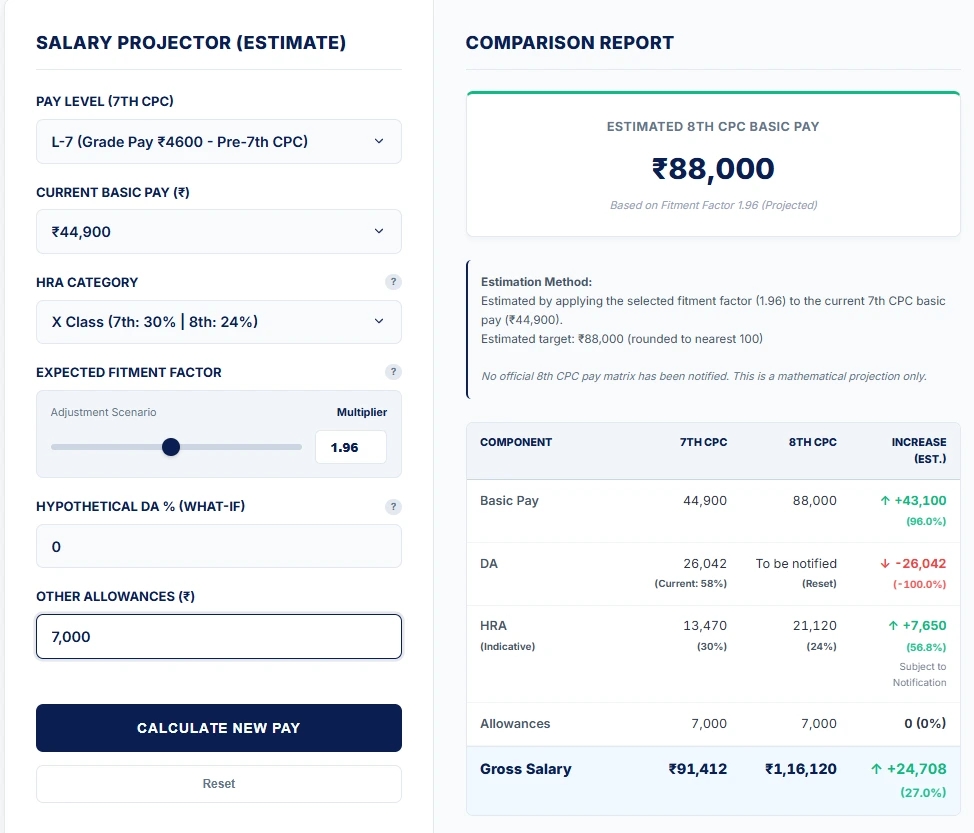
Let’s take a realistic example to understand how the estimated numbers change using our 8th Pay Commission salary calculation logic. Consider an employee at Level 7 (typical Section Officer or Inspector level), posted in an X-class city.
Current 7th CPC Salary Structure (Indicative)
- Basic Pay: ₹44,900
- Dearness Allowance (58% approx): ₹26,042
- House Rent Allowance (30% of Basic): ₹13,470
- Other Allowances (TA and applicable components): ₹7,000 (approx, varies by posting)
Estimated Gross Salary (7th CPC):
₹91,412/- per month (approx)
Projected 8th CPC Salary Structure (Estimation)
Now, let’s apply an expected fitment factor of 1.96 for estimation purposes.
- Estimated New Basic Pay: ₹88,000 (approx)
- Dearness Allowance: ₹0 (typically reset after DA merger)
- Revised HRA (24% of new Basic): ₹21,120
- Other Allowances: Likely revised separately but we assume the same ₹7,000
Estimated Gross Salary (8th CPC):
₹1,16,120/- per month (indicative)
The Net Impact
Even though Dearness Allowance resets to zero, the Basic Pay nearly doubles, which significantly increases HRA in absolute terms. Other allowances, while subject to separate review, are generally added on top of the revised Basic Pay.
The key takeaway:
The increase under the 8th Pay Commission comes primarily from a higher Basic Pay, which then raises the overall salary base. This is why a 7th vs 8th CPC salary comparison should always focus on the entire structure, not just DA percentages.
You can use the calculator above to run this comparison for your own pay level, city category, and assumed fitment factor.
Who Can Use This 8th Pay Commission Salary Calculator?
This tool is designed for a wide range of government personnel:
- Central Government Employees: From Level 1 (MTS) to Level 18 (Cabinet Secretary), the matrix covers all standard pay scales.
- Defense Personnel: This calculator can give a broad indicative idea of basic pay revision. Defence specific allowances and structures are not included.
- Pensioners: As mentioned, you can use this as an 8th pay commission pension calculator by taking 50% of the projected Basic Pay as your tentative pension.
- State Government Employees: Some state governments later align their pay structures with Central Pay Commission recommendations, with modifications. This calculator gives state employees a preview of their future pay revision.
Common Misconceptions About the 8th Pay Commission
There is a lot of fake news circulating on WhatsApp regarding salary hikes. Let’s bust a few myths using logic.
Myth 1: “The 8th Pay Commission is cancelled.” Fact: There is no official statement canceling it. Pay revision is a standard administrative cycle. While there may be delays or new formulas, a revision is inevitable to adjust for inflation.
Myth 2: “Salary will double instantly.” Fact: While the Basic Pay might double, the gross salary usually sees a hike of 15% to 25% initially because the DA merges into the Basic. Use the 8th pay commission calculator to see the real difference, not the rumored one.
Myth 3: “Fitment factor is finalized at 3.68.” Fact: This is a demand by the JCM (Joint Consultative Machinery), not a government order. It is safer to calculate using conservative figures like 1.96 or 2.57 to avoid disappointment.
Frequently Asked Questions – 8th Pay Commission Salary Calculator
Related Calculator
Salary revision is only one part of long-term planning. Pension structure also plays a crucial role after retirement.
UPS vs NPS Calculator
Compare estimated pension benefits under the Unified Pension Scheme (UPS) and the National Pension System (NPS). This tool helps you understand potential retirement outcomes based on service tenure and contribution assumptions.
8th Pay Commission Pension Calculator
Retirement planning starts with the right numbers. Use our 8th pay commission pension calculator to estimate your revised basic pension and family pension. By applying projected fitment factors to your current 7th CPC figures, you can visualize your post-retirement financial security with ease.
Disclaimer
This 8th Pay Commission Salary calculator and the accompanying content are estimation and comparison tools intended for informational purposes only. The results shown are mathematical projections based on user-inputted assumptions, selected fitment factors, and historical pay revision patterns.
The Government of India has not yet notified the official 8th Pay Commission Pay Matrix or implementation rules. Actual salary figures may differ due to future policy decisions, changes in allowance structures, HRA city classifications, tax deductions, or other service-specific conditions.
The information provided should not be considered official, legal, or financial advice and should not be relied upon for any legal, service-related, or official claims.