
Use this free Income Tax Calculator to instantly compare your tax liability under the Old and New Tax Regimes for tax year FY 2026-27. Simply enter your gross salary, standard deduction, and eligible investments (like 80C or HRA) to calculate your final tax payable and discover which regime saves you the most money.
Detailed Income Tax Computation
• Standard Deduction: ₹75,000 (New) / ₹50,000 (Old) on Salary.
• Professional Tax (Sec 16): Only deductible under Old Regime (max ₹2,500).
• Section 87A Rebate: Base income up to ₹12L (New) and ₹5L (Old) is tax-free.
• Surcharge: 10% (>₹50L), 15% (>₹1Cr), 25% (>₹2Cr). 37% for Old Regime >₹5Cr.
• 80D Deduction: Automatically capped based on age group and parent senior citizen status.
• Marginal Relief is automatically applied to both base slabs and surcharge boundaries.
• Health & Education Cess is 4%.
Income Tax Slabs Reference (FY 2026-27)
| New Regime Slabs | Tax Rate |
|---|---|
| Up to ₹ 4,00,000 | Nil |
| ₹ 4,00,001 - ₹ 8,00,000 | 5% |
| ₹ 8,00,001 - ₹ 12,00,000 | 10% |
| ₹ 12,00,001 - ₹ 16,00,000 | 15% |
| ₹ 16,00,001 - ₹ 20,00,000 | 20% |
| ₹ 20,00,001 - ₹ 24,00,000 | 25% |
| Above ₹ 24,00,000 | 30% |
| Old Regime Slabs (< 60 Yrs) | Tax Rate |
|---|---|
| Up to ₹ 2,50,000 | Nil |
| ₹ 2,50,001 - ₹ 5,00,000 | 5% |
| ₹ 5,00,001 - ₹ 10,00,000 | 20% |
| Above ₹ 10,00,000 | 30% |
Wondering how we arrived at your final number? Once you enter your details into the Income Tax Calculator FY 2026-27, the tool instantly processes your information against the latest government rules to give you a clear and accurate estimate.
Here is exactly how the math works behind the scenes: First, the calculator adds up your total earnings, such as your salary and any interest income. Next, it applies the standard deduction based on the tax system you are evaluating—subtracting ₹75,000 for the new regime and ₹50,000 for the old regime. If you entered any tax-saving investments (like PPF, LIC, or health insurance), the tool correctly subtracts those from your old regime calculation. Then, it runs your remaining net income through the updated tax slabs for both systems simultaneously.
The system also automatically checks if you qualify for government tax discounts. For example, when checking your Income Tax Calculator New Regime results, if your taxable income sits at or below the ₹12 Lakh safe limit, the tool applies the Section 87A rebate to drop your tax bill straight to zero. Finally, it calculates the mandatory 4% Health and Education Cess on any remaining balance.
The number you see on your screen represents your projected tax payable for FY 2026-27 (AY 2027-28). It does all this complex math in a fraction of a second so you can easily compare both regimes and plan your yearly budget with complete confidence.
What Is an Income Tax Calculator?
An Income Tax Calculator FY 2026-27 is a smart digital tool designed to replace complicated spreadsheets and manual math. Instead of trying to memorize tax slab rates or figure out which deductions apply to you, the tool processes everything automatically based on the latest Indian tax laws.
Most people just want a way to calculate tax quickly to see how much of their hard-earned money will actually hit their bank account. By simply typing in your salary and investments, an online income tax calculator does the heavy lifting. A high quality Income Tax Calculator India will give you the option to test different scenarios and compare the old and new systems using an integrated Old and New Tax Regime Calculator. Whether you are a private sector employee, Government employee or a freelancer, this is the easiest way to forecast your finances.
How to Use the Income Tax Calculator for FY 2026-27 (AY 2027-28)
You don’t need to be a financial expert to figure out your taxes. Using the Income Tax Calculator FY 2026-27 takes less than two minutes, and the best part is that it automatically evaluates both tax systems for you simultaneously.
Here is exactly how to use it:
- Select your Age Group: Start by choosing your age bracket (0-60, 60-80, or 80+ years). This ensures the tool applies the correct basic exemption limit for your profile.
- Enter your Income Details: Input your gross salary. If you have other sources of money, like bank interest, rental income, or digital assets, enter those as well.
- Declare your Deductions: Fill in your allowances (like HRA) and tax-saving investments under Chapter VI-A (such as Section 80C, health insurance under 80D, and home loan interest). Note: The tool is smart enough to apply these only where legally permitted.
- Click Calculate: Hit the “Calculate Tax” button to instantly process your data.
- Review the Comparison: Instead of making you guess, the calculator will automatically display a side-by-side breakdown of both the Old and New Regimes. It will instantly highlight the “Winner” and tell you exactly which regime saves you the most money.
This makes learning how to calculate income tax on salary in india completely stress-free. It essentially functions as a highly accurate in hand salary calculator, showing you exactly what is left over for you to spend or save.
Who Can Use This Income Tax Calculator 2026
This tool is built for a wide variety of Indian taxpayers. If you earn an income, you need to know your tax liability. This includes:
- Salaried corporate employees
- Government employees
- Freelancers and consultants
- Business owners
- Retirees earning pension or interest income
Government pay structures can be unique. If you are looking for an accurate salary tax calculation india government employees tool, or trying to do a tax calculation for government employees india, this calculator factors in components like your DA and NPS deductions flawlessly to give you a reliable estimate.
Old vs New Tax Regime Comparison
India currently operates on two parallel tax systems. Finding out which one is better for your wallet is the main reason people use an Old and New Tax Regime Calculator.
Old vs New Tax Regime Comparison
| Feature | Old Tax Regime | New Tax Regime |
| Tax slabs | Higher percentage rates | Lower percentage rates |
| Deductions | Allowed (80C, 80D, HRA, etc.) | Mostly not allowed |
| Standard deduction | Yes (₹50,000) | Yes (₹75,000) |
| Complexity | Requires lots of math and proofs | Very simple and paperless |
| Best for | People with heavy investments/home loans | Individuals who want high take-home pay |
The old regime rewards you for locking your money into specific tax-saving investments. The new regime offers lower tax rates upfront but removes those investment benefits. By running an Income Tax Calculator New Regime comparison alongside your old regime numbers, you can easily spot the winner.
Old vs New Tax Regime Comparison: Which Should You Choose?
The new tax system was introduced with one main goal: simplicity. It lets you keep more of your paycheck without forcing you to buy insurance policies or mutual funds just to save tax.
The Case for the New Tax Regime
- Pros: Lower tax rates across the board. A higher standard deduction of ₹75,000. And most importantly, if your taxable income is up to ₹12.75 Lakhs, your tax drops to zero.
- Cons: You lose your House Rent Allowance (HRA), Leave Travel Allowance (LTA), and Section 80C benefits.
The Case for the Old Tax Regime
- Pros: You can stack massive deductions. If you maximize Section 80C (₹1.5 Lakh), add extra NPS (₹50k), and claim home loan interest (up to ₹2 Lakh), you can drastically shrink your taxable income.
- Cons: The tax slabs are punishingly high if you don’t have enough deductions, and submitting investment proofs to your HR department can be a headache.
The Break-Even Rule If you are confused, follow this general rule of thumb:
- If your total tax-saving deductions are below ₹4 Lakh, the Income Tax Calculator New Regime will almost certainly save you money.
- If your deductions exceed ₹4.25 Lakh (usually because of a home loan), the old regime might still be your best bet. Always use an income tax calculator new vs old regime check before making your final declaration to your employer.
Income Tax Slab Rates for FY 2026-27
To accurately project your taxes, you need to know the latest Income Tax Slabs for FY 2026-27. These are the default rates for all taxpayers under the new regime.
| Income Range | Tax Rate |
| Up to ₹4,00,000 | 0% |
| ₹4,00,001 – ₹8,00,000 | 5% |
| ₹8,00,001 – ₹12,00,000 | 10% |
| ₹12,00,001 – ₹16,00,000 | 15% |
| ₹16,00,001 – ₹20,00,000 | 20% |
| ₹20,00,001 – ₹24,00,000 | 25% |
| Above ₹24,00,000 | 30% |
Note: Because of the special Section 87A rebate built into the new regime, if your income after the standard deduction stays under ₹12 Lakhs, your final tax liability is zero.
Income Tax Slabs Under the Old Tax Regime
If you have high deductions and choose the old regime, your tax rate depends on your age.
Individuals Below 60 Years
| Income Range | Tax Rate |
| Up to ₹2,50,000 | 0% |
| ₹2,50,001 – ₹5,00,000 | 5% |
| ₹5,00,001 – ₹10,00,000 | 20% |
| Above ₹10,00,000 | 30% |
Senior Citizens (60–80 Years)
| Income Range | Tax Rate |
| Up to ₹3,00,000 | 0% |
| ₹3,00,001 – ₹5,00,000 | 5% |
| ₹5,00,001 – ₹10,00,000 | 20% |
| Above ₹10,00,000 | 30% |
Super Senior Citizens (Above 80 Years)
| Income Range | Tax Rate |
| Up to ₹5,00,000 | 0% |
| ₹5,00,001 – ₹10,00,000 | 20% |
| Above ₹10,00,000 | 30% |
These are the exact mathematical brackets applied when you check the old regime inside the Income Tax Calculator India.
Surcharge and Health & Education Cess
Your base tax is not your final tax. The government applies additional levies depending on your total income.
| Total Income | Surcharge Rate |
| ₹50 lakh – ₹1 crore | 10% |
| ₹1 crore – ₹2 crore | 15% |
| ₹2 crore – ₹5 crore | 25% |
| Above ₹5 crore | 25% (New Regime) 37% (Old Regime) |
Health and Education Cess
After your base tax and any surcharge are calculated, a flat 4% Health and Education Cess is added to the total. An online income tax calculator factors this in automatically so you aren’t caught off guard.
Rebate Under Section 87A
Section 87A is the most powerful tax-saving tool for the middle class. It acts as a direct discount on your final tax bill.
| Tax Regime | Rebate Eligibility | Maximum Rebate Amount |
| New Regime | Taxable income up to ₹12 lakh | Up to ₹60,000 |
| Old Regime | Taxable income up to ₹5 lakh | Up to ₹12,500 |
If you stay within these limits, your tax becomes zero. However, note that special income like Long-Term Capital Gains on stocks may not qualify for this rebate.
Important Rules: Surcharges, Cess, and Marginal Relief
No Income Tax Calculator which is online is truly complete without factoring in the extra levies charged by the government for high earners.
- Health and Education Cess (4%): Whether you earn ₹10 Lakhs or ₹10 Crores, an additional 4% cess is calculated on your base tax amount and added to your final liability.
- Surcharge for High-Income Earners: If your total income crosses ₹50 Lakhs, you enter the surcharge zone. This is essentially a “tax on your tax.” The rates are 10% (for ₹50L to ₹1Cr), 15% (for ₹1Cr to ₹2Cr), and 25% (for ₹2Cr to ₹5Cr). If you earn above ₹5 Crores, the surcharge caps at 25% in the New Regime, but hits a punishing 37% in the Old Regime.
- Marginal Relief: What happens if you earn ₹50,10,000? Do you suddenly pay lakhs in extra surcharge just because you crossed the threshold by a few thousand rupees? No. The government provides “Marginal Relief” to ensure the extra tax you pay never exceeds the extra income you earned. Our calculator automatically handles this complex math for you in the background.
Example Tax Calculations
Let’s look at real math to see how an Income Tax Calculator for FY 2026-27 proesses different salary levels and deductions.
Example 1: Annual Salary of ₹10,00,000
For a taxpayer with no extra tax-saving investments.
- New Regime: * Calculation: ₹10,00,000 minus ₹75,000 standard deduction = ₹9,25,000 taxable income.
- Result: Because this is well below the ₹12 Lakh threshold, the Section 87A rebate wipes the tax completely.
- Tax Payable: ₹0
- Old Regime: * Calculation: ₹10,00,000 minus ₹50,000 standard deduction = ₹9,50,000 taxable income.
- Result: Without any Section 80C investments, the base tax comes to ₹1,02,500 + 4% cess.
- Tax Payable: ₹1,06,600
🏆 Winner: New Regime (Saves you over ₹1 Lakh in taxes!)
Example 2: Annual Salary of ₹15,00,000
For a taxpayer with no extra tax-saving investments.
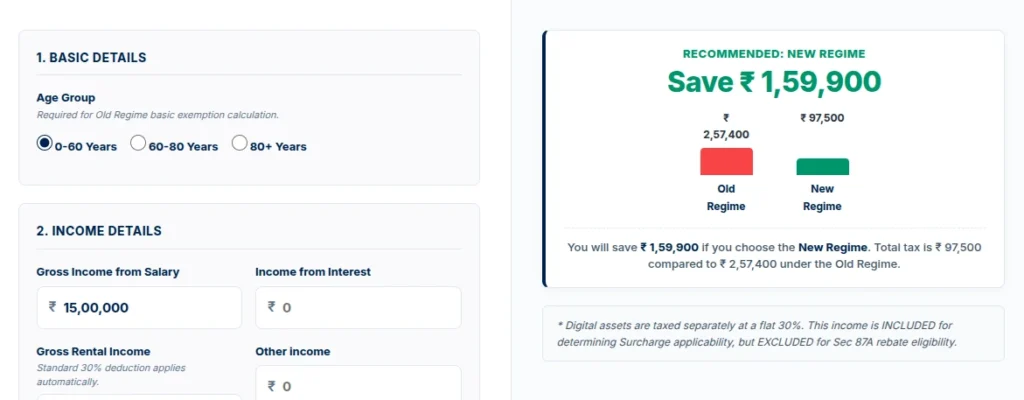
- New Regime: * Calculation: ₹15,00,000 minus ₹75,000 standard deduction = ₹14,25,000 taxable income.
- Result: Applying the new slabs, the base tax is ₹93,750 + 4% cess.
- Tax Payable: ₹97,500
- Old Regime: * Calculation: ₹15,00,000 minus ₹50,000 standard deduction = ₹14,50,000 taxable income.
- Result: Applying the old slabs, the base tax is ₹2,47,500 + 4% cess.
- Tax Payable: ₹2,57,400
🏆 Winner: New Regime (Saves you ₹1,59,900 compared to the old regime).
Example 3: Annual Salary of ₹20,00,000 (With Heavy Deductions)
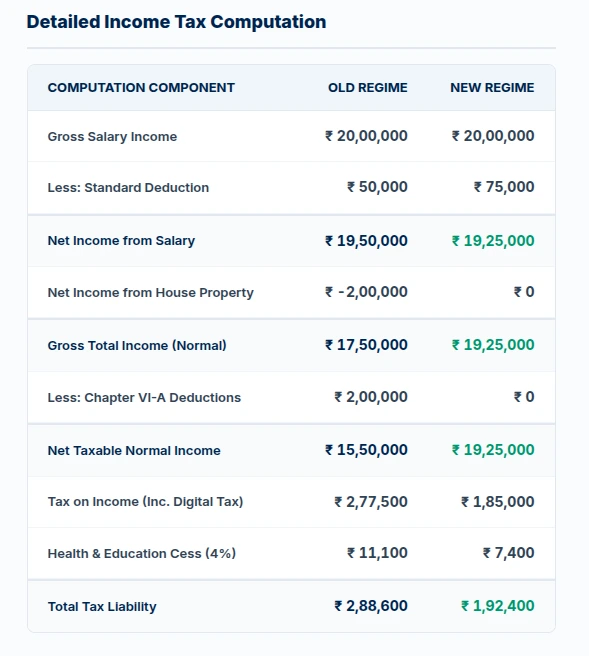
Let’s assume this taxpayer claims a total of ₹4 Lakhs in deductions: ₹1.5 Lakh under 80C, ₹50,000 under NPS (80CCD), and ₹2 Lakhs for home loan interest.
- New Regime: * Calculation: Most deduction benefits are ignored, but you still get the ₹75,000 standard deduction. Taxable income is ₹20,00,000 minus ₹75,000 = ₹19,25,000.
- Result: Applying the new slabs, the base tax is ₹1,85,000 + 4% cess.
- Tax Payable: ₹1,92,400
- Old Regime: * Calculation: Deductions are allowed. ₹20,00,000 minus ₹50,000 (Std Ded) minus ₹4,00,000 (Investments) = ₹15,50,000 taxable income.
- Result: Applying the old slabs, the base tax is ₹2,77,500 + 4% cess.
- Tax Payable: ₹2,88,600
🏆 Winner: New Regime (Even with a massive ₹4 Lakhs in deductions, the New Regime is still cheaper by ₹96,200 due to the significantly lower slab rates).
How Income Tax Is Calculated on Salary
For salaried employees, the math starts by adding up your total earnings. Your Gross Salary includes: Basic Pay, House Rent Allowance (HRA), special allowances, and bonuses. Next, you add income from other sources, such as savings account interest, rental income, or capital gains.
Once your gross total income is calculated, exemptions (like HRA) and deductions (like 80C) are subtracted if you are using the old regime. The remaining amount is your net taxable income, which is pushed through the tax slabs. This exact workflow is what an Income Tax Calculator FY 2026-27 automates for you in a fraction of a second.
Why You Need an In-Hand Salary Calculator Today
Relying on mental math or outdated formulas to predict your tax is risky. Using an online income tax calculator provides major financial advantages.
- Accurate Salary Estimation: An in hand salary calculator tells you exactly what your monthly take-home pay will be after the government takes its cut.
- Scenario Testing: You can use an income tax calculator with deductions india to see if investing ₹1.5 Lakhs in an ELSS fund actually saves you enough tax to be worth the lock-in period.
- Saves Time: Instead of spending hours reading tax law documents, a Tax Calculator FY 2026-27 gives you the right answer instantly, protecting you from filing errors.
Who Should Choose the New Tax Regime?
The new regime is not a one-size-fits-all solution, but it is highly beneficial for a specific demographic.
It is generally the best choice for:
- Salaried employees without major deductions like home loans.
- Young professionals and freelancers starting their careers.
- Individuals who want a simple, hassle-free tax filing experience.
- Anyone with a gross salary under ₹12.75 Lakhs (as their tax will be zero).
Conversely, if you are paying off a massive home loan and have deep investments in PPF and insurance, you should run the numbers for the old regime before switching.
Benefits of Using an Income Tax Calculator
Why should you bookmark this page?
- Quick Tax Estimation: The Income Tax Calculator FY 2026-27 gives you a reliable figure immediately.
- Easy Comparison: You don’t have to guess. Running an income tax calculator new vs old regime check removes all the doubt.
- Better Tax Planning: If you estimate your taxes in April instead of March, you have 11 months to pace your investments rather than scrambling at the last minute.
- User Friendly: It requires no financial degree to operate—just type in your salary and get your results.
Frequently Asked Questions
Final Thoughts
Understanding your tax liability shouldn’t be stressful. Whether you are a Government employe, corporate worker, a freelancer, or using this as an Income Tax Calculator FY 2026-27 for your salary, getting ahead of your taxes puts you in control of your wealth.
Always use an Old and New Tax Regime Calculator early in the year. By doing so, you can structure your investments wisely, prevent excess TDS from eating into your monthly budget, and ensure you keep as much of your hard-earned money as legally possible.
Disclaimer
This calculator provides an estimated tax calculation based on the information you enter and the current Indian tax rules for FY 2026-27. The results should be considered indicative and meant for personal planning purposes only. They may not represent the exact tax payable down to the final rupee. For official calculations, investment advice, or filing purposes, please consult a qualified Chartered Accountant (CA) or refer directly to the official Income Tax Department guidelines.