
If your current basic pay is ₹____, here’s how it could change under different projected fitment factors:
| Current Basic | 2.57 | 2.86 | 3.68 |
|---|---|---|---|
| ₹18,000 | ₹46,260 | ₹51,480 | ₹66,240 |
| ₹25,000 | ₹64,250 | ₹71,500 | ₹92,000 |
| ₹40,000 | ₹1,02,800 | ₹1,14,400 | ₹1,47,200 |
👉 Want exact calculation including DA, HRA and allowances?
🔵 Calculate Your 8th CPC Salary Instantly →
The fitment factor is a multiplier applied to your existing basic pay to determine your revised salary under the 8th Pay Commission. While no official number has been announced, projections currently range from 2.57 to 3.68.
If you are a government employee or pensioner, this multiplier will determine your revised basic pay, influence allowances such as HRA and TA, and ultimately shape your income for the next decade.
In this guide, we break down what these numbers mean, how salary calculations work, and what you can realistically expect.
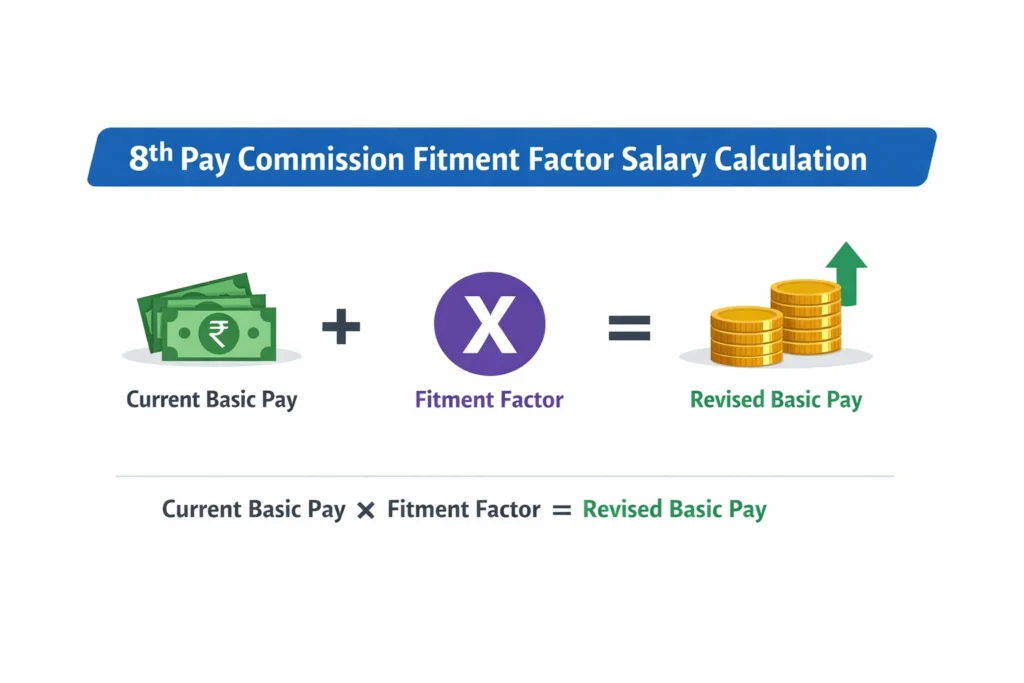
The salary calculation formula under the 8th Pay Commission is explained below:
- What Is the 8th Pay Commission Fitment Factor?
- 2.57 vs 2.86 vs 3.68 – Understanding the Three Scenarios
- Step-by-Step 8th Pay Commission Salary Calculation
- Comparison Table: 2.57 vs 2.86 vs 3.68 Fitment Factor Impact
- Level-Wise Impact Estimates
- Impact on Pensioners
- What Is Officially Confirmed So Far?
- When Could Implementation Happen?
- Final Thoughts
- Frequently Asked Questions (FAQs)
- Disclaimer
What Is the 8th Pay Commission Fitment Factor?
The fitment factor is a fixed multiplier used to convert your existing basic pay into a revised basic pay when a new Pay Commission is implemented.
The formula is simple:
Current Basic Pay × Fitment Factor = New Basic Pay
When a new commission is introduced, the Dearness Allowance (DA) accumulated over the years is typically merged into the new basic pay, and DA is reset to zero. The fitment factor ensures that this transition results in an overall upward revision rather than a neutral adjustment.
Even small changes in the multiplier — for example, from 2.57 to 2.86 — can translate into substantial differences in monthly salary and long-term earnings.
For pensioners, the same multiplier is generally applied to the existing basic pension to determine the revised pension amount.
2.57 vs 2.86 vs 3.68 – Understanding the Three Scenarios
At present, three figures are widely discussed in policy debates and employee representations. However, it is important to note that no official confirmation has been issued regarding the final fitment factor.
Let’s examine each scenario carefully.
Scenario 1: 2.57 (Historical Benchmark)
The 7th Pay Commission implemented a fitment factor of 2.57 in 2016.
At that time:
- Minimum basic pay (6th CPC): ₹7,000
- After applying 2.57: ₹17,990 (rounded to ₹18,000)
If the same multiplier were applied again under the 8th CPC:
- Current Minimum Basic Pay: ₹18,000
- Multiplied by 2.57
- Revised Basic Pay: ₹46,260
While this scenario represents continuity with the previous commission, many analysts believe inflation trends since 2016 may require a higher adjustment.
Scenario 2: 2.86 (Moderate Projection)
The figure 2.86 frequently appears in financial discussions and employee estimates. This projection is generally based on:
- Inflation trends since 2016
- CPI-IW movement
- Real wage correction arguments
If 2.86 is applied:
- Current Minimum Basic Pay: ₹18,000
- Multiplied by 2.86
- Revised Basic Pay: ₹51,480
This scenario represents a balanced approach — offering meaningful salary enhancement while remaining within fiscal considerations.
Some internal projections and independent financial models place expectations broadly between 2.70 and 2.90, although this remains speculative.
Scenario 3: 3.68 (Higher-End Discussion Figure)
Certain employee associations have proposed a multiplier around 3.68, citing cost-of-living pressures and wage erosion concerns.
If implemented:
- Current Minimum Basic Pay: ₹18,000
- Multiplied by 3.68
- Revised Basic Pay: ₹66,240
However, historically, Pay Commissions have calibrated increases carefully, balancing employee welfare with fiscal sustainability. A multiplier of this magnitude would significantly increase the government’s salary expenditure.
At present, this remains a demand — not an official proposal.
Step-by-Step 8th Pay Commission Salary Calculation
To understand how the fitment factor impacts your income, let’s look at a structured example.
Step 1: Calculate New Basic Pay
Assume:
- Current Basic Pay (Level 6): ₹35,400
- Projected Fitment Factor: 2.86
Calculation:
₹35,400 × 2.86 = ₹1,01,244
This becomes the revised basic pay before rounding adjustments.
Step 2: Dearness Allowance Reset
By the time the 8th Pay Commission is implemented — widely expected around 2026 based on historical cycles — DA could be in the range of 55–60%, depending on inflation trends.
When the new commission comes into effect:
- Existing DA is merged into basic pay
- DA resets to zero
- Future DA begins accumulating again
Step 3: House Rent Allowance (HRA)
HRA is calculated as a percentage of basic pay.
Under a new commission:
- HRA percentages may be revised downward
- But since the basic pay increases substantially, the actual HRA amount usually rises
Example:
24% of ₹1,01,244 is significantly higher than 30% of ₹35,400.
Step 4: Other Allowances
Transport Allowance, Non-Practicing Allowance (for eligible medical professionals), hardship allowances, and other departmental benefits are added based on revised structures.
Because rounding rules and matrix adjustments can vary, using an automated tool is recommended for accuracy.
👉 You can calculate your projected revised salary using our 8th Pay Salary Calculator, which incorporates multiplier scenarios and allowance adjustments.
Comparison Table: 2.57 vs 2.86 vs 3.68 Fitment Factor Impact
To understand the difference clearly, here is a side-by-side comparison of projected salary revisions under different fitment factor scenarios.
| Current Basic Pay | 2.57 Multiplier | 2.86 Multiplier | 3.68 Multiplier |
| ₹18,000 | ₹46,260 | ₹51,480 | ₹66,240 |
| ₹35,400 | ₹90,978 | ₹1,01,244 | ₹1,30,272 |
| ₹44,900 | ₹1,15,393 | ₹1,28,414 | ₹1,65,232 |
| ₹56,100 | ₹1,44,177 | ₹1,60,446 | ₹2,06,448 |
Key Observations:
- A difference of just 0.29 (2.57 → 2.86) can increase monthly basic pay by over ₹10,000 in mid-level pay grades.
- A multiplier like 3.68 significantly increases government salary expenditure.
- Higher multipliers also increase HRA, TA, and other allowance calculations since they are linked to basic pay.
- Pension revisions would follow the same multiplication logic.
This table provides a simplified illustration. The official 8th CPC pay matrix may apply rounding rules and rationalization adjustments.
Level-Wise Impact Estimates
Group D (Level 1)
Current Basic: ₹18,000
- 2.57 → ₹46,260
- 2.86 → ₹51,480
- 3.68 → ₹66,240
Group B (Level 7 Example)
Current Basic: ₹44,900
- 2.57 → ₹1,15,393
- 2.86 → ₹1,28,414
- 3.68 → ₹1,65,232
Group A (Level 10 Example)
Current Basic: ₹56,100
- 2.57 → ₹1,44,177
- 2.86 → ₹1,60,446
- 3.68 → ₹2,06,448
Note: These are theoretical multiplications. The official 8th CPC Pay Matrix may include rounding rules and rationalization indices.
Impact on Pensioners
The fitment factor directly affects pension revision.
Current minimum basic pension: ₹9,000
- 2.57 → ₹23,130
- 2.86 → ₹25,740
- 3.68 → ₹33,120
Dearness Relief (DR) would also be merged and reset when the new commission takes effect.
This revision would impact:
- Commuted pension calculations
- Gratuity limits
- Leave encashment ceilings
If you are nearing retirement, projecting pension outcomes under different multipliers is essential.
What Is Officially Confirmed So Far?
- No official fitment factor has been announced.
- The 8th Pay Commission discussions are ongoing.
- The implementation date has not yet been formally notified in the Gazette.
- All multiplier figures currently circulating are projections or demands — not confirmed decisions.
Always rely on official notifications for final decisions.
When Could Implementation Happen?
Historically, Central Pay Commissions have been implemented from January 1 of a new cycle year. Based on this precedent, many analysts expect the 8th CPC to follow a similar pattern, potentially around January 2026.
However, until formal notification is issued, timelines remain indicative.
If implementation is retrospective, arrears would likely be paid for the period between the effective date and actual salary disbursement.
Final Thoughts
The debate between 2.57, 2.86, and 3.68 reflects broader discussions about inflation, fiscal space, and wage sustainability.
While higher projections generate optimism, financial planning should be based on moderate and realistic scenarios until official figures are announced.
Regardless of the final multiplier, the 8th Pay Commission fitment factor will:
- Redefine the pay matrix
- Reset the DA framework
- Influence allowances
- Impact pension revision
To avoid manual calculation errors, use our 8th Pay Salary Calculator to instantly compare different multiplier scenarios based on your pay level and city classification.
Frequently Asked Questions (FAQs)
Disclaimer
This article is for informational and educational purposes only. The fitment factor figures (2.57, 2.86, 3.68) discussed above are projections and public estimates based on discussions and employee representations. No official announcement has been made regarding the final fitment factor or implementation date of the 8th Pay Commission. Final decisions will depend on formal government notifications and recommendations.